> ## Documentation Index
> Fetch the complete documentation index at: https://docs.swai.app/llms.txt
> Use this file to discover all available pages before exploring further.
# Architecture
> An overview of how SWAI components work together
**SWAI is currently under active development**
The platform is evolving rapidly, and components, APIs, and documentation may change frequently as we refine and enhance the system.
SWAI is designed with a modular architecture that allows different components to work together seamlessly while maintaining flexibility for creators.
This overview provides a high-level understanding of how the system is structured — and how it powers real-time logic inside CTZN.
## Core Components
The SWAI platform consists of four primary modules that work in harmony to create intelligent, adaptive agent systems:
The decision-making center that combines AI reasoning with state machines to create predictable yet intelligent behavior patterns.
The comprehensive memory system that manages short-term, long-term, and shared memory across agents and user experiences.
The event processing system that enables real-time responses to on-chain behaviour, social inputs, and user interactions.
The action layer that executes skills and enables agents to interact with users, systems, and the world.
## How They Work Together
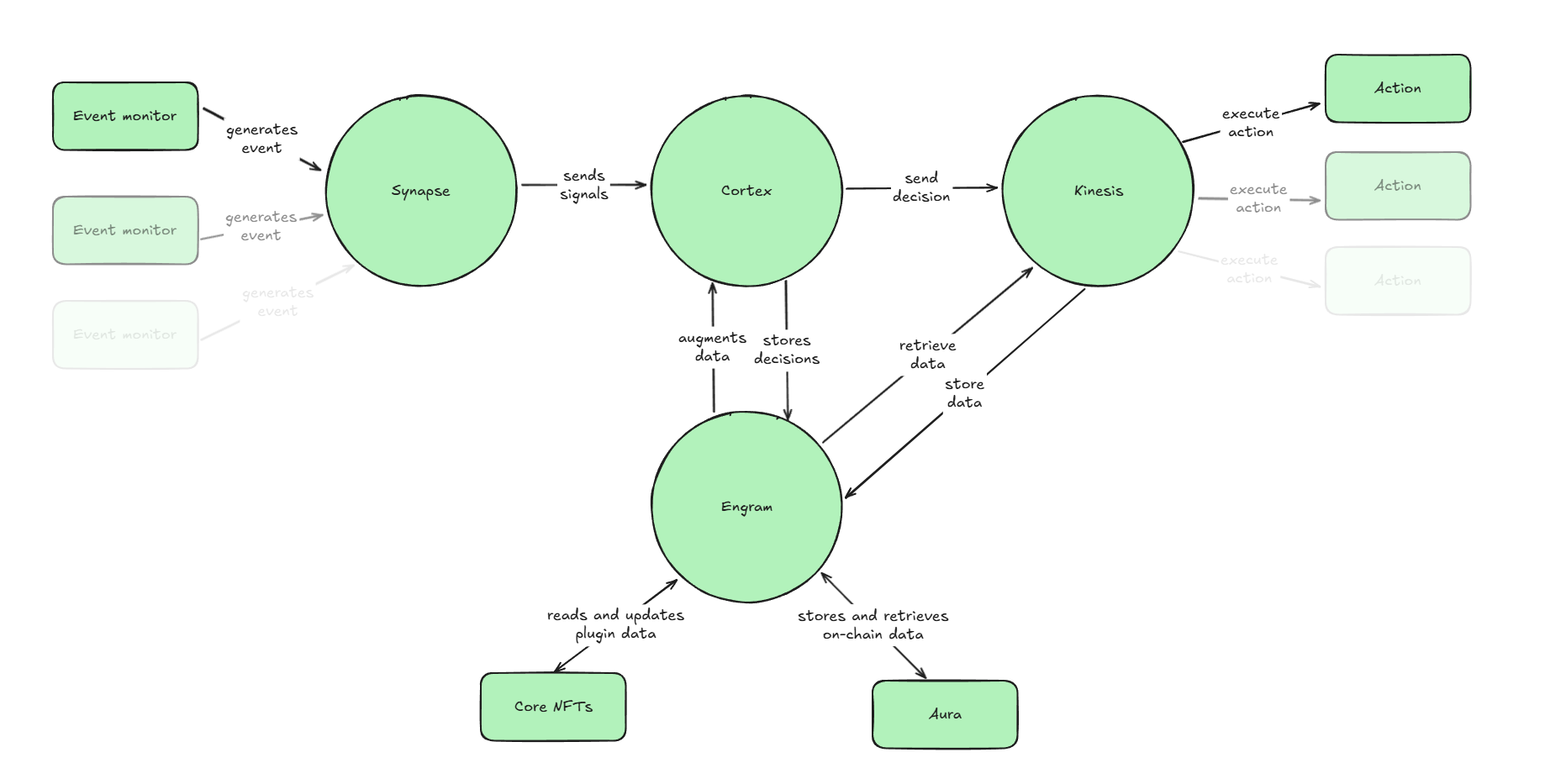 The SWAI architecture follows an information flow that mimics human cognition:
1. **Perception** - Events and inputs are processed through Synapse
2. **Memory** - Information is stored and retrieved via Engram
3. **Decision** - The Cortex evaluates options and determines actions
4. **Action** - Kinesis executes the chosen actions in the environment
This cycle creates a continuous feedback loop that allows agents to learn, adapt, and evolve over time — which is core to how SWAI drives scoring and outcomes within CTZN.
## Design Philosophy
SWAI's architecture is built on three core principles:
Components can be used independently or together, allowing for flexible implementation.
The system is designed to handle everything from basic scoring logic to complex, multi-agent ecosystems.
SWAI works with existing AI models, blockchain systems, and web services through standardized interfaces.
This modular approach means you can start with just the components you need and expand your implementation as your requirements grow.
In the following sections, we'll dive deeper into each component and provide practical examples of how they can be implemented in your projects.
The SWAI architecture follows an information flow that mimics human cognition:
1. **Perception** - Events and inputs are processed through Synapse
2. **Memory** - Information is stored and retrieved via Engram
3. **Decision** - The Cortex evaluates options and determines actions
4. **Action** - Kinesis executes the chosen actions in the environment
This cycle creates a continuous feedback loop that allows agents to learn, adapt, and evolve over time — which is core to how SWAI drives scoring and outcomes within CTZN.
## Design Philosophy
SWAI's architecture is built on three core principles:
Components can be used independently or together, allowing for flexible implementation.
The system is designed to handle everything from basic scoring logic to complex, multi-agent ecosystems.
SWAI works with existing AI models, blockchain systems, and web services through standardized interfaces.
This modular approach means you can start with just the components you need and expand your implementation as your requirements grow.
In the following sections, we'll dive deeper into each component and provide practical examples of how they can be implemented in your projects.